What Is Meta Andromeda (in Simple Language)?
In 2025, Meta quietly rewired how Facebook and Instagram ads work under the hood. The change is called Andromeda – Meta’s new AI-powered ad retrieval engine.
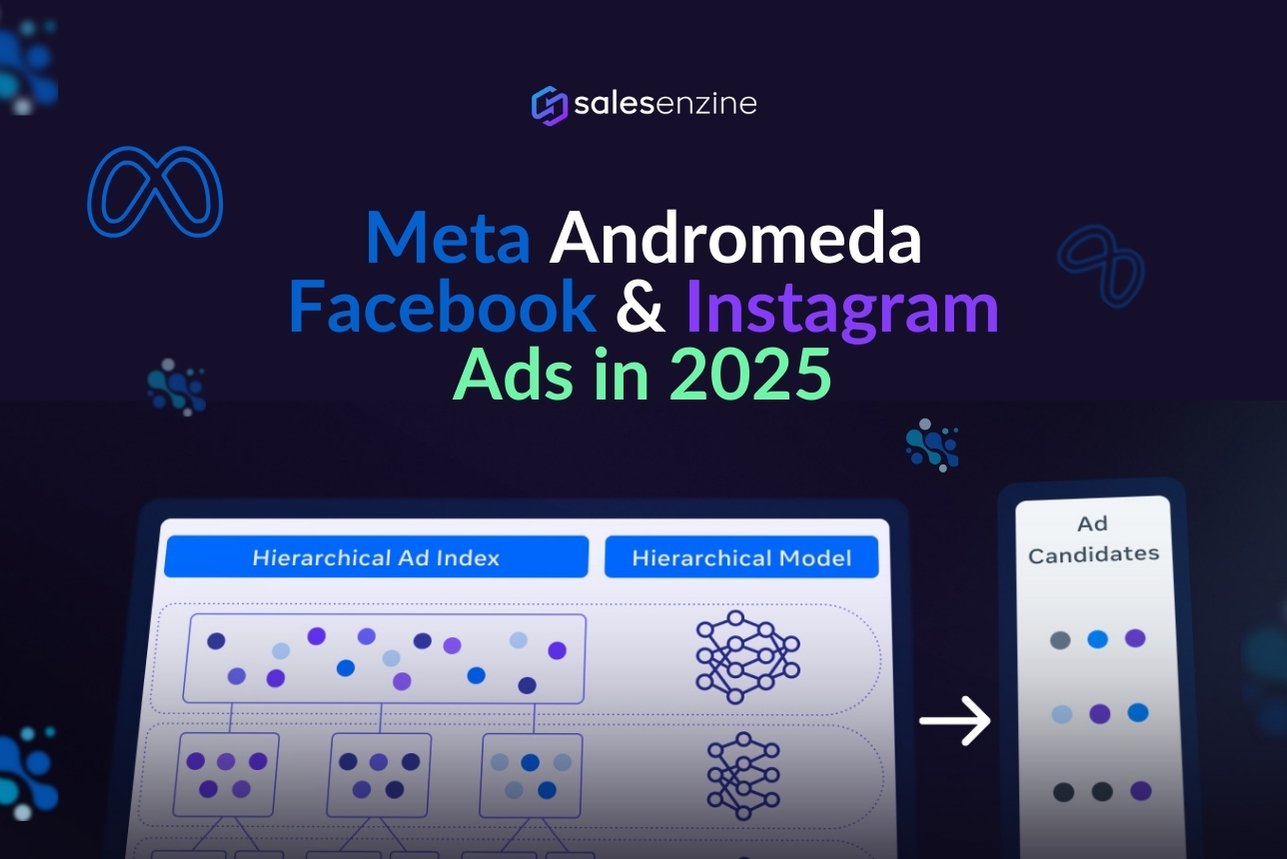
Before, Meta relied heavily on rule-based logic and multiple smaller models to decide which ads to show. Now, Andromeda acts like a powerful AI filter:
- Every time someone opens Facebook or Instagram, there are tens of millions of possible ads that could be shown.
- Andromeda scans this huge pool and narrows it down to a few thousand highly relevant candidates.
- Then, a separate system (Lattice) ranks those candidates and decides which ads actually get impressions.
Meta reports that Andromeda has improved ad quality and relevance by around 8% on average, thanks to better retrieval and more powerful hardware (Meta’s MTIA chips + NVIDIA Grace Hopper).
The key takeaway for advertisers:
You no longer “win” with micro-targeting tricks. You win by feeding Andromeda the right signals: strong creatives, clean data, and simple campaign structures.
How Andromeda Changes Facebook & Instagram Advertising
Andromeda isn’t a new button inside Ads Manager. You’re already using it if you run Meta ads in 2025. What’s changed is how the system responds to your setup.
1. Less Power in Manual Targeting, More in Creative & Signals
Previously, many advertisers relied on things like:
- Narrow interest stacks
- Tiny lookalike buckets
- 20+ ad sets with small budgets
In the Andromeda era:
- Meta wants broader audiences and fewer artificial constraints.
- The system uses behavioural data, creative content, and context to auto-find the right users.
That means your advantage comes from:
- How well your creative hooks match user intent.
- How rich and varied your creative library is.
- How clean and accurate your conversion data and customer lists are.
2. Advantage+ and Automation Become the Default
Andromeda is tightly integrated with Advantage+ campaigns (Shopping, App, and others). These formats give the AI:
- More placements to test
- More signals across the full funnel
- More control over creative and audience matching
If you still run everything manually with rigid structures, you’re competing against advertisers who let Andromeda use the full toolkit.
3. Testing Shifts From “Targeting vs Targeting” to “Creative vs Creative”
Instead of testing:
“Interest Stack A vs Interest Stack B”
you now get better results testing:
“Offer angle A vs Offer angle B”
“UGC-style video vs polished lifestyle clip”
“Problem–solution hook vs social proof hook”
The algorithm cares less about your interest labels and more about how people actually respond to each creative.
How to Structure Meta Campaigns for the Andromeda Era
Let’s turn this into a practical blueprint you can use for e-commerce, info products, or lead generation.
Step 1: Simplify Your Campaign Structure
Instead of 15–20 ad sets per campaign, aim for lean, high-signal structures.
Example structure (e-commerce):
- Prospecting – Advantage+ Shopping (Main Cold Campaign)
- Objective: Sales / Purchase
- Targeting: Broad (country, age, language)
- Budget: 40–70% of total ad budget
- Use: Advantage+ Shopping, Advantage+ Audience
- Prospecting – Standard CBO (Backup / Experiment Campaign)
- 1–3 ad sets:
- Broad
- Broad + Lookalike (e.g. 1–5% purchasers)
- Budget: 10–30% of total
- Use for testing new creative concepts without breaking your main campaign.
- 1–3 ad sets:
- Retargeting – CBO or Single Ad Set
- Audience: Website visitors, Add-to-Cart, IGEngagers, Video >50% etc.
- Budget: 10–20% of total
- Shorter attribution windows and higher frequency are fine here.
For lead gen, replace Purchase with Lead or a deeper event like Qualified Lead, but keep the same logic: one main cold engine, one test engine, one retargeting engine.
Step 2: Go Broad on Targeting (But Smart on Signals)
Andromeda works best when it has room to explore.
Do:
- Target by location + age + language as your minimum.
- Use Advantage+ Audience or broad targeting rather than stacking many interests.
- Include lookalikes as soft signals, not hard walls (e.g. using them in one ad set alongside broad).
Avoid:
- Over-segmentation by gender, age brackets, micro-interests, unless you have a very specific reason.
- 10 different ad sets with tiny budgets and overlapping audiences.
- Aggressive exclusions that prevent the model from seeing patterns.
Remember: Andromeda is built to handle the complexity you’re trying to “control” manually. Let it.
Step 3: Build a Creative Library That Andromeda Can Feast On
Creative is where you now win or lose.
Aim for 6–10 Distinct Creative Concepts per Main Ad Set
Not 10 small variations of the same thing – 10 different angles, for example:
- UGC testimonial video – customer talking about results.
- Problem–solution explainer – show the pain, then the product.
- Pure product demo – short, fast, feature-focused.
- Lifestyle + benefit – emotional and aspirational.
- Offer/urgency creative – limited-time, bundles, bonuses.
- Comparison / “why us” – vs competitors or vs old way of doing things.
Meta’s own guidance and multiple independent analyses underline that diverse creatives give Andromeda more options to match the right ad to the right person at the right time.
Mix Formats and Placements
- Vertical video (Reels, Stories)
- Square video or image (Feed)
- Carousels
- Catalog / product ads (for e-commerce)
Each format creates additional signals about:
- What people watch vs scroll past
- Where they convert
- Which hooks work best for different contexts
Use AI, but Maintain Brand Control
Meta and other tools can now generate creative variations at scale. That’s useful, but:
- Approve only variants that match your brand look and tone.
- Turn off auto-tweaks that distort colours, fonts, or messaging too much.
Think of AI as your assistant art director, not your brand owner.
Step 4: Strengthen Your Data & Conversion Signals
If Andromeda is the brain, your tracking is the senses. Weak signals = bad decisions.
1. Use Pixel + Conversion API
Set up:
- Meta Pixel on your site or funnel
- Conversion API (CAPI) via your platform, server integration, or third-party tool
This ensures:
- Events still fire even when browser tracking is limited
- Andromeda sees more complete conversion paths
- Optimization is based on real revenue, not just clicks
2. Optimize for the Right Event
- For e-commerce: Purchase (with value)
- For lead gen: ideally a deeper event than just Lead, such as:
- QualifiedLead
- BookedCall
- SubmittedApplication
If you only optimize for shallow events (views, basic leads), Andromeda will find people who are good at filling forms, not necessarily becoming customers.
3. Feed High-Quality First-Party Data
Upload and refresh:
- Past purchasers
- High-value customers
- Subscribers or engaged leads
- People who completed your main “success” action
Use these as:
- Seeds for lookalike audiences
- Warm segments in retargeting
- Sources of insights for creative (what they cared about, which pain points, etc.)
The cleaner your data, the better Andromeda becomes at finding more people like your best customers.
Step 5: Rethink Testing and Optimization
Your role shifts from campaign micromanager to experiment designer.
Move from Micro-Tests to Strategic Tests
Instead of testing:
- Button colours
- Tiny copy changes
- 5% budget tweaks
Start testing:
- Positioning (premium vs affordable vs fastest)
- Offers (discount vs bonus vs guarantee vs bundle)
- Creative style (UGC vs studio vs motion graphics)
Use Meta’s built-in A/B Tests or split campaigns only when the hypothesis is meaningful.
Give Andromeda Enough Time & Data
As a rule of thumb:
- Try to reach at least 50 optimization events per week per ad set (Purchase, Lead, etc.).
- Avoid resetting the learning phase by making big edits every day.
- When performance dips, add new creatives into a stable campaign rather than rebuilding from scratch.
Measure Beyond In-Platform ROAS
Attribution is increasingly noisy. Combine:
- In-platform metrics (ROAS, CPC, CPM)
- Blended CAC, MER (Marketing Efficiency Ratio)
- Revenue from your CRM / e-commerce platform
This gives you a truer picture of whether Andromeda is helping or hurting overall profitability.
Practical Checklist: Is Your Account Ready for Meta Andromeda?
When you launch or clean up an account, run through this checklist:
- Objectives & Events
- Main campaign objective matches your real goal (Sales, Leads, App Promotion)
- Optimizing for Purchase or a meaningful down-funnel event
- Tracking & Data
- Pixel installed and firing correctly
- Conversion API implemented
- Standard events + key custom conversions set up
- High-quality customer lists uploaded and updated
- Campaign Structure
- 1 main prospecting engine (Advantage+ where relevant)
- 1–2 test / experiment campaigns
- 1 retargeting campaign with clear segments
- No over-fragmented budgets or unnecessary audience splits
- Targeting Approach
- Broad or Advantage+ Audience in main campaigns
- Minimal exclusions (only where clearly justified)
- Lookalikes used as supportive signals, not crutches
- Creative Library
- 6–10 distinct creative concepts per core ad set
- Mix of UGC, problem–solution, social proof, offer, and lifestyle
- Multiple formats (Reels, feed video, image, carousel)
- Ongoing creative refresh plan (e.g. 2–3 new concepts every 2–4 weeks)
- Testing & Optimization
- Clear hypotheses (“Angle A vs Angle B”), not random testing
- Budget sized to generate enough weekly events
- Decisions made on 3–7 days of data, not 12 hours
- Reporting includes blended metrics, not just ad platform numbers
If you can tick most of these boxes, you’re already ahead of the majority of advertisers who are still fighting the old battle of “which interest is best.”
Final Thoughts: Treat Andromeda as an Opportunity, Not a Threat
Meta’s Andromeda update isn’t just another small tweak. It’s a paradigm shift:
- From manual control → AI-driven retrieval and ranking
- From audience hacking → creative and data excellence
- From short-term tricks → systems built around signal quality
Brands that cling to old habits—narrow targeting, over-segmentation, random testing—will see rising costs and inconsistent results. The ones that win will:
- Embrace broader structures and Advantage+
- Invest in creative strategy, not just media buying
- Build clean, rich first-party data
- Let Andromeda do what it does best: match the right ad to the right person at scale
If you adapt your strategy now, Meta Andromeda stops being a black box to fear and becomes an unfair advantage for your campaigns.