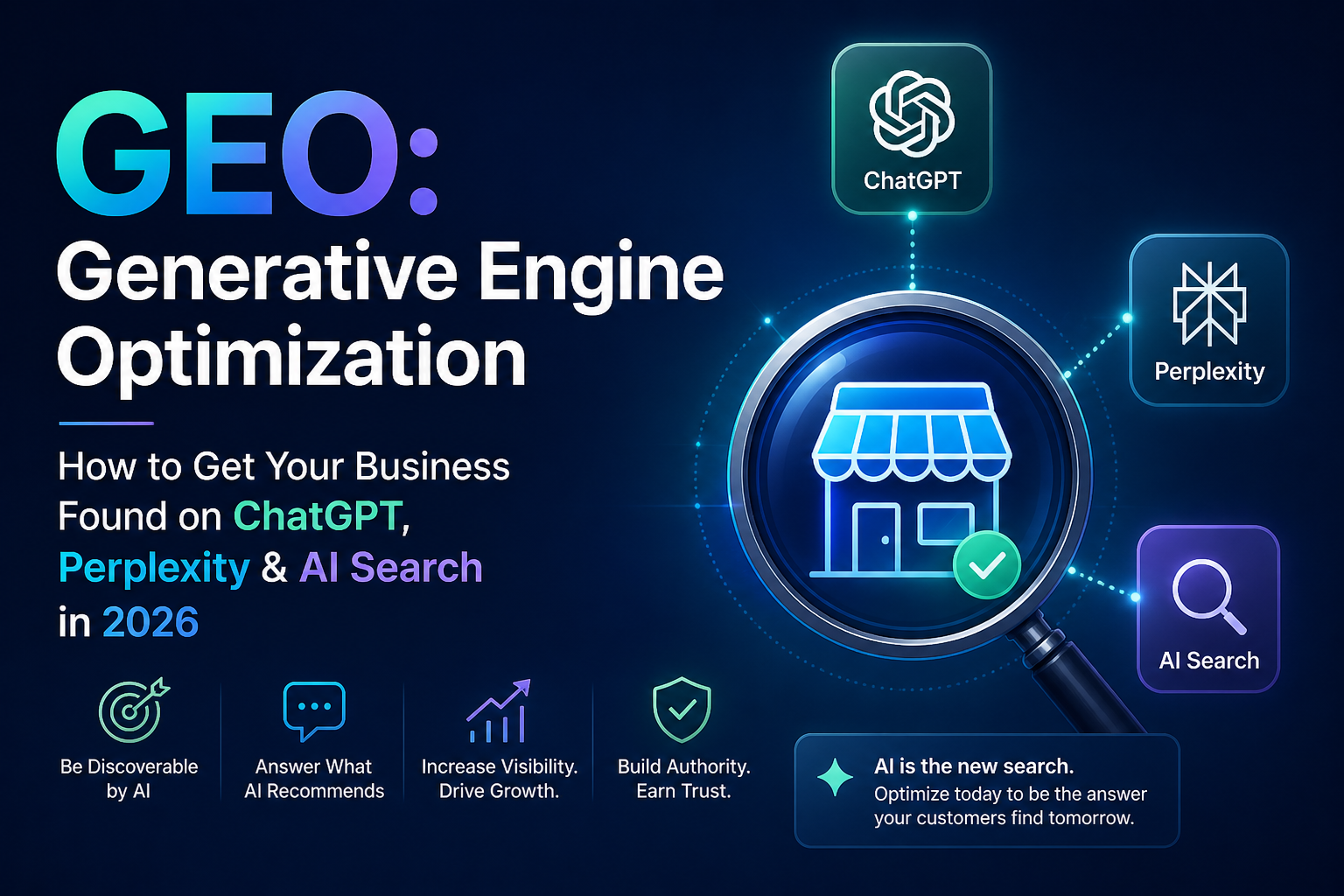
Search has changed. The customers you used to win on page one of Google are now asking ChatGPT, Perplexity, Gemini, and Claude for recommendations and getting confident, conversational answers that often include only three or four brands. If your business is not one of them, you are invisible.
That is the gap Generative Engine Optimization (GEO) is built to close. GEO is the discipline of structuring your content, brand signals, and digital presence so that AI generative engines surface your business when buyers ask the questions that matter to your revenue. It is not a replacement for SEO, it is the natural next layer, and the businesses that adopt it now will own the AI shelf for years.
This guide breaks down what GEO is, how it differs from traditional SEO, the seven pillars of an effective GEO strategy, a four-phase implementation roadmap, and how to measure performance. Whether you run a local service business, a marketing agency, or a growing SaaS brand, you will leave with a clear plan to get found in the AI era.
What Is Generative Engine Optimization (GEO)?
Generative Engine Optimization (GEO) is the practice of optimizing content, brand signals, and structured data so that large language model–powered search tools like ChatGPT, Perplexity, Google AI Overviews, Gemini, Microsoft Copilot, and Claude — cite your business when answering user prompts. Where traditional SEO targets a ranked list of blue links, GEO targets the synthesized, conversational answer the AI gives directly to the user.
Think of it this way: SEO got you onto the shelf. GEO gets you into the recommendation.
When a prospect types “best cold email automation tools for SMBs” into ChatGPT, the AI doesn’t show ten links it names a handful of solutions, summarizes their value, and sometimes links out. GEO is what determines whether your name appears in that shortlist.
GEO vs SEO: What’s Actually Different?
GEO and SEO share DNA but optimize for different end states. SEO maximizes click-through from a results page; GEO maximizes citation inside an AI-generated answer. Here is how the two compare.
| Dimension | Traditional SEO | Generative Engine Optimization (GEO) |
|---|---|---|
| Goal | Rank in the SERP | Get cited inside the AI answer |
| User behavior | Types short keywords, scans links | Asks full questions in natural language |
| Content style | Keyword-targeted pages | Direct, structured, citation-ready answers |
| Authority signal | Backlinks + on-page signals | Brand mentions, entities, structured data, third-party citations |
| Format winners | Long-form articles, guides | Q&A blocks, lists, tables, schema-rich pages, original data |
| Measurement | Rankings, organic clicks | AI citations, brand share-of-voice in LLM answers, referral traffic from AI tools |
The key insight: GEO does not replace SEO — it builds on top of it. The same E-E-A-T signals (Experience, Expertise, Authoritativeness, Trustworthiness) that win on Google also feed the language models. The difference is in how content is structured, how often your brand is mentioned across the web, and whether AI engines can quickly extract a clean, factual answer from your pages.
Why GEO Matters for Your Business in 2026
AI search has moved from novelty to default in less than two years. ChatGPT alone serves hundreds of millions of weekly users. Google’s AI Overviews now appear above organic results for a growing share of commercial queries. Perplexity has positioned itself as a direct alternative to traditional search. Every one of these platforms is rerouting traffic away from the ten blue links and toward synthesized answers.
Five concrete reasons GEO is no longer optional:
- Increased AI visibility — Appear more often in answers across ChatGPT, Perplexity, Gemini, Claude, Copilot, and Google AI Overviews.
- AI-optimized content structure — Format your pages so language models can parse and quote them cleanly.
- Discoverability for buying-intent prompts — Get recommended when users ask AI for products, services, or local business suggestions.
- Prompt and keyword alignment — Match how people actually phrase questions in conversational AI tools, not just how they type into Google.
- Future-proofing your traffic — Stay ahead of the shift from search engines to answer engines, and protect your pipeline as click-through rates on traditional SERPs decline.
If you wait until your competitors are already cited by ChatGPT, you will be playing catch-up against entrenched citations. The AI engines tend to repeat the sources they trust — which means early movers compound.
How AI Generative Engines Choose What to Cite
To do GEO well, you need a working model of how language models surface information. While each engine has its own retrieval pipeline, most follow a similar pattern:
- Retrieval — When a user submits a prompt, the engine queries a search index (its own crawler and/or partners like Bing or Google) to pull a set of candidate sources.
- Ranking — Candidates are ranked based on relevance, authority, recency, and structural clarity — the same way classic search ranks, but with extra weight on extractability.
- Synthesis — The model reads the top candidates, blends them with its training-data priors, and generates a coherent answer.
- Citation selection — The engine picks which sources to credit. Sources that are cleanly structured, authoritative, and easy to quote are favored.
What this means in practice: AI engines reward pages that look like reference material. Clear headings. Short, factual answers near the top of each section. Tables and lists that summarize key points. Schema markup that labels entities. And — critically — pages from brands that are already mentioned, reviewed, and cited across other trustworthy sites.
The 7 Pillars of an Effective GEO Strategy
These are the seven levers that move the needle in AI search. You do not need to nail all seven on day one, but a brand that ranks well in ChatGPT or Perplexity has typically earned strong scores across most of them.
1. Citation-Worthy, Structured Content
Write pages that AI engines can read like a textbook. Lead each section with a one- or two-sentence direct answer to the question implied by the heading. Follow with supporting detail. Use bulleted lists, numbered steps, comparison tables, and short paragraphs. Avoid burying the key fact under three paragraphs of throat-clearing — language models often extract the first concise definition they find.
2. Entity and Topical Authority
AI engines reason about the world in entities — people, brands, products, places, concepts — and the relationships between them. Build topical authority by publishing a deep cluster of content around your core entity (your brand, your category) rather than scattering one-off articles. The more your domain becomes a recognized authority on a topic, the more the engines will lean on you when answering related prompts.
3. Schema Markup and Machine-Readable Signals
Implement structured data using Schema.org — Organization, Product, Service, FAQPage, HowTo, Article, Review, and LocalBusiness schemas all help AI systems understand exactly what your page is about. Add author bios with sameAs links to LinkedIn and X. Include published and modified dates. Mark up FAQs explicitly. Every machine-readable signal you add lowers the cost of citing you.
4. Conversational, Prompt-Aligned Content
Stop optimizing only for two- and three-word keywords. People talk to AI in full sentences: “What’s the best CRM for a small real estate team in 2026?” or “How do I automate cold email follow-ups without sounding spammy?” Build content that mirrors these natural-language prompts. Use them as headings. Answer them directly in the first paragraph. This is where keyword research evolves into prompt research.
5. Brand Mentions Across the Open Web
Backlinks still matter, but unlinked brand mentions have become a powerful GEO signal. AI training and retrieval pipelines pick up on how often your brand is named in industry publications, podcasts, Reddit threads, YouTube transcripts, comparison articles, and review sites. Public relations, guest posts, podcast appearances, community presence, and customer reviews all feed into your AI visibility.
6. Original Data, Statistics, and Quotes
Language models love primary sources. If you publish original research, benchmark reports, customer studies, or proprietary statistics, you become the canonical citation for that data — and AI engines will name you over and over. Even small original numbers (“we analyzed 1,200 cold-email campaigns and found…”) give engines a reason to cite you specifically.
7. Multimodal and Long-Tail Coverage
Cover the long tail of related questions across formats. Publish video answers (transcribed and indexed), images with descriptive alt text, infographics with structured data, and downloadable resources. AI engines increasingly synthesize across modalities, and broad coverage of a topic — not just one flagship article — wins the citation race.
Your GEO Implementation Roadmap (4 Phases)
Most businesses get stuck because they try to overhaul everything at once. Instead, run GEO in phases. Each phase builds on the last and produces measurable wins.
Phase 1: Audit and Baseline (Weeks 1–2)
- Run prompt tests. Ask ChatGPT, Perplexity, Gemini, and Claude the 20–30 questions your customers actually use to find businesses like yours. Note who gets cited.
- Audit your top 25 pages for structure, schema, and answer-first formatting.
- Inventory existing brand mentions across the web (use Google search, Reddit, and tools like Brand24 or Mention).
- Document a baseline: how often your brand is named in AI answers vs. competitors.
Phase 2: Foundation Fixes (Weeks 3–6)
- Rewrite the top 10 commercial pages with answer-first leads, FAQ blocks, comparison tables, and clear headings.
- Implement Schema.org markup site-wide (Organization, Product/Service, FAQPage, Article, LocalBusiness as relevant).
- Add detailed author bios with credentials, photos, and sameAs links.
- Fix technical SEO basics — crawlability, page speed, mobile, internal linking. AI engines still rely on crawlers.
Phase 3: Authority Building (Weeks 7–12)
- Publish 1–2 original research pieces with proprietary statistics in your niche.
- Run a focused PR push — guest posts, podcast appearances, expert quotes in industry roundups.
- Build a content cluster of 12–20 prompt-aligned articles around your core entity.
- Activate review and reputation systems — get on G2, Capterra, Trustpilot, Google Business, and category-specific directories.
Phase 4: Optimize and Compound (Ongoing)
- Re-run prompt tests monthly to track citation share-of-voice.
- Refresh top pages every quarter to keep recency signals strong.
- Double down on prompts where you are gaining ground; rebuild content for prompts where you are losing.
- Expand into adjacent topic clusters as your core entity authority compounds.
Common GEO Mistakes That Quietly Kill Visibility
- Burying the answer. Long, flowery intros push the key fact past the model’s extraction window. Lead with the answer; expand below.
- Keyword-stuffed thin content. AI engines penalize generic, low-information pages even more aggressively than Google does. Depth wins.
- Ignoring brand-building. If you have zero presence on Reddit, podcasts, or industry sites, no amount of on-page SEO will get you cited. Visibility lives off-site too.
- Skipping schema. It is the cheapest, highest-leverage GEO move you can make. Almost every site under-uses it.
- Treating GEO as one-time. AI engines retrain and re-rank constantly. GEO is a quarterly cadence, not a launch project.
- Optimizing for the wrong prompts. Run real tests before writing. Don’t guess what people are asking.
How to Measure GEO Performance
GEO measurement is still maturing, but a clear set of metrics has emerged. Track these monthly:
- AI citation rate — the percentage of priority prompts where your brand is named in the AI answer.
- Share of voice in AI — your citation rate divided by the combined citation rate of you and your top three competitors.
- Referral traffic from AI tools — sessions in Google Analytics with source/medium tagged as ChatGPT, Perplexity, Gemini, Copilot, etc.
- Brand mention velocity — monthly count of unlinked and linked brand mentions across the open web.
- Branded prompt growth — how often people are asking AI tools specifically about your brand (“is [brand] worth it?”, “[brand] vs [competitor]”).
- Schema coverage — the percentage of priority pages with valid structured data.
Tools like Profound, Otterly.ai, AthenaHQ, Peec AI, and even manual prompt tracking via spreadsheet can give you a working dashboard. The key is consistency — measure the same prompts at the same cadence so trend lines mean something.
Where GEO Fits Into Your Wider Marketing Engine
GEO is most powerful when it plugs into a complete sales and marketing engine — one where AI visibility feeds traffic, traffic feeds nurture, nurture feeds calls, and calls feed revenue. A clean GEO strategy wins the citation. A clean funnel turns the citation into a customer.
That is the philosophy behind everything we build at Salesenzine: not isolated tactics, but integrated systems. Your AI-optimized content brings in qualified prospects from ChatGPT and Perplexity. Behavior-triggered email and SMS sequences nurture them. Your AI receptionist and smart-chat concierge convert them. Your CRM and appointment system close them. GEO is the front door — but the engine is what turns visitors into paying customers.
The Future of Search Is Already Here
Within the next two to three years, expect AI-generated answers to dominate the discovery phase of nearly every buying journey — B2B, B2C, local, and e-commerce. Voice assistants powered by language models will pull from the same citation pools. Embedded AI in browsers, productivity tools, and operating systems will surface recommendations without the user ever opening a search bar.
The brands that show up in those answers will be the ones that started earning citations now — building structured content, clean schema, original data, and a recognizable presence across the web. The brands that don’t will spend the next decade buying ads to compensate for invisibility they could have prevented.
GEO is not a side bet. It is the new front line of organic visibility.
Frequently Asked Questions About GEO
Is GEO replacing SEO?
No. GEO is an extension of SEO. The same authority signals — strong content, technical health, backlinks, brand mentions — feed both. GEO simply adds a layer of structure, schema, and prompt-aligned formatting that helps AI engines extract and cite your content.
How long does GEO take to show results?
Foundation fixes (schema, answer-first formatting, FAQ blocks) can produce visibility shifts within four to eight weeks. Authority-building moves like original research and PR compound over three to six months. Like SEO, GEO is a long game — but the early-mover advantage is real.
Do small businesses actually benefit from GEO?
Yes — often more than enterprises. Local and niche prompts often have fewer authoritative sources, which means a well-optimized SMB site can quickly become the canonical citation for a city, service, or specialization. GEO levels the playing field.
Which AI engines should I optimize for first?
Start with ChatGPT, Perplexity, and Google AI Overviews — they collectively cover the largest share of commercial AI search. Gemini, Copilot, and Claude often pull from overlapping sources, so the work compounds.
Can I do GEO myself or do I need an agency?
Foundational GEO is doable in-house with a strong content team and clear process. Where agencies add the most value is in scale: prompt research, structured-data implementation, original research production, and the ongoing PR work that builds brand mentions across the web. Most growing businesses get the best return from a hybrid model.
Ready to Get Found in the AI Era?
At Salesenzine, we build complete growth engines that fuse GEO, SEO, paid media, automation, and conversion systems into one revenue-driving stack. If you want your business cited by ChatGPT, ranked on Google, and converting visitors on autopilot, we will map your strategy and tell you exactly what to launch first.
👉 Book a free strategy call with our growth team — and let’s build your AI-ready engine before your competitors do.