Customers today do not interact with businesses through only one channel. They check email, read text messages, browse social media, visit websites, compare reviews, and often move between several devices before making a purchase.
That is why relying on email alone—or SMS alone—can limit your email marketing performance and reduce overall reach.
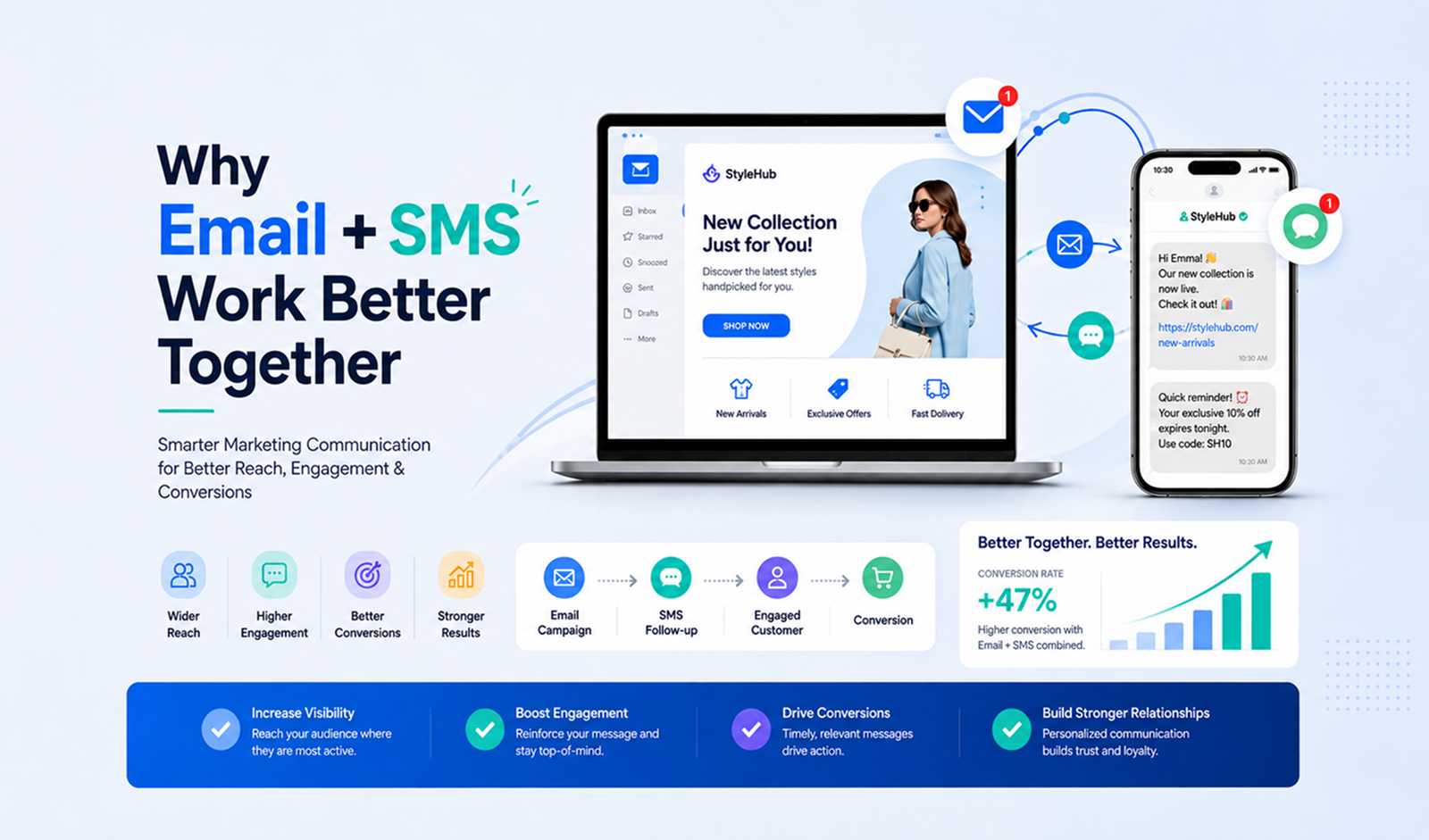
Email and SMS serve different purposes. Email gives you space to explain, educate, nurture, and sell. SMS gives you speed, visibility, urgency, and immediacy.
When businesses combine the two strategically, they can create a marketing communication system that reaches customers at the right time, with the right message, through the right channel.
Instead of asking whether you should use email or SMS marketing, the better question is:
How can email and SMS work together to create a better customer experience and generate more revenue?
This guide explains why combining email and SMS marketing work better together, how each channel should be used, and how to build campaigns without overwhelming your audience.
Email and SMS Are Different and That Is Their Biggest Advantage
Email and SMS should not simply repeat the exact same message.
They work best because they have different strengths.
Email is ideal for depth
Email gives marketers room to communicate more detailed information.
You can use email for:
- Educational content
- Newsletters
- Product explanations
- Case studies
- Customer stories
- Offers and promotions
- Product recommendations
- Visual campaigns
- Long-form sales messages
- Event announcements
- Lead nurturing
- Onboarding sequences
- Post-purchase communication
An email can contain images, multiple products, testimonials, videos, links, FAQs, and detailed calls to action.
SMS is ideal for immediacy
SMS is much shorter.
That limitation is actually one of its strengths.
A text message can quickly communicate something important such as:
- Your appointment is tomorrow.
- Your sale ends tonight.
- Your order has shipped.
- Your coupon expires soon.
- Your webinar starts in one hour.
- Your abandoned cart is still available.
- Your reservation is confirmed.
- A limited product is back in stock.
SMS is designed for messages that benefit from being seen quickly.
That means the two channels naturally complement one another.
Email explains. SMS reminds.
Email nurtures. SMS prompts action.
Email provides depth. SMS provides urgency.
1. You Increase the Chances That Your Message Gets Seen
One of the biggest challenges in digital marketing is simply getting someone’s attention.
A customer may subscribe to your email list but not check their inbox today.
Another customer may see your email but intend to take action later—and forget.
SMS gives you another opportunity to reconnect with that person.
For example, imagine you are promoting a 20% discount that runs from Friday through Sunday.
Your campaign could look like this:
Friday morning — Email
Introduce the promotion, explain the benefits, feature products, provide testimonials, and include the discount code.
Saturday afternoon — SMS
Your 20% weekend offer is live. Shop before Sunday night: [link]
Sunday evening — Email
Remind customers about the products or services included in the promotion.
Sunday night — SMS
Final hours: Your 20% offer ends tonight. Use code WEEKEND20: [link]
You are not depending on a single email to generate the entire response.
Instead, both channels reinforce the campaign.
2. Email Builds the Story While SMS Creates Urgency
Consider a company launching a new service.
Trying to explain the entire service through a 160-character text message would be difficult.
Email is much better suited for the initial communication.
The company could send an email explaining:
- The problem
- Why the problem matters
- The solution
- How the service works
- Benefits
- Pricing
- Testimonials
- Frequently asked questions
- Call to action
Then SMS can be used later.
For example:
Still interested in simplifying your marketing? Your introductory offer ends tomorrow. See the details here: [link]
The email does the heavy lifting.
The SMS creates the timely reminder.
This approach is generally more effective than trying to force every marketing message into one channel.
3. SMS Can Support Important Email Campaigns
Businesses spend considerable time creating newsletters, promotions, product announcements, and nurturing campaigns.
But not every subscriber will open every email.
SMS can support especially important campaigns.
For example:
Subject: Registration is now open for our free marketing workshop
The email explains the event, speakers, topics, date, benefits, and registration process.
SMS later
Registration is now open for Thursday’s free marketing workshop. Reserve your seat: [link]
Then on the event day:
We’re starting in 1 hour. Here’s your access link: [link]
Email delivers the information.
SMS helps make sure important moments are not missed.
4. Combining Channels Creates Better Lead Nurturing
Many leads do not buy immediately.
Someone may download a guide, request information, book a consultation, start a trial, or visit a pricing page without becoming a customer.
These prospects often need additional communication.
An integrated email and SMS sequence works best when you start by building a dedicated email list of engaged prospects.
For example:
Day 0 — Email
“Thanks for requesting our guide.”
Deliver the resource and introduce the company.
Day 1 — SMS
Hi Sarah, your guide was sent yesterday. If you have any questions, you can reply to this text.
Day 3 — Email
Send educational content addressing a common problem.
Day 6 — Email
Share a customer success story.
Day 8 — SMS
Want to see how this could work for your business? Book a quick consultation here: [link]
Day 12 — Email
Answer common objections and explain the offer.
This creates a much more natural communication experience than sending one promotional email after another.
5. Email + SMS Can Improve Abandoned Cart Recovery
Ecommerce companies can benefit significantly from combining both channels.
Imagine a customer adds a $120 product to their shopping cart but leaves without purchasing.
An automated recovery sequence could include:
1 hour later — Email
Forgot something?
Show the exact product left in the cart.
8 hours later — SMS
Your cart is still waiting. Complete your order here: [link]
24 hours later — Email
Explain product benefits and include customer reviews.
48 hours later — SMS
Last reminder: Your cart is still available. Finish checkout here: [link]
Instead of sending four emails, you alternate channels.
That variation can make the communication feel more natural while keeping the brand visible.
6. SMS Can Make Time-Sensitive Offers More Effective
Some communications are highly dependent on timing.
Examples include:
- Flash sales
- Event reminders
- Appointment confirmations
- Limited inventory
- Product drops
- Restaurant reservations
- Webinar reminders
- Holiday deadlines
- Shipping cutoffs
- Ticket sales
Email may introduce the opportunity several days earlier.
SMS can be used when the deadline approaches.
For example:
Email Monday
Our summer sale starts today — save up to 30%.
SMS Thursday
Summer Sale reminder: Save up to 30% before the promotion ends Sunday. Shop here: [link]
SMS Sunday
Final hours. Summer Sale ends tonight: [link]
SMS becomes especially valuable when the action needs to happen soon.
7. Email Can Educate While SMS Moves the Customer Forward
One common marketing mistake is trying to sell too quickly.
Customers often need education before they feel comfortable making a decision.
This is especially true for businesses offering:
- Professional services
- Healthcare services
- Financial services
- B2B services
- Marketing services
- Software
- High-value products
- Subscription services
Email can provide educational content over several days or weeks.
For example:
Email 1: The problem customers commonly experience
Email 2: Why the problem happens
Email 3: Common mistakes
Email 4: How to solve the problem
Email 5: Customer success story
Then SMS can provide an easy next step:
Ready to discuss your situation? Book your consultation here: [link]
SMS does not need to educate the customer from the beginning.
The emails have already done that work.
8. Combining Email and SMS Marketing Helps Drive People Back to Your Content
SMS does not always need to link directly to a product or landing page.
You can also use it to highlight valuable email content.
For example:
We just sent you our 5-step guide to reducing customer acquisition costs. Check your inbox when you have a minute.
This can be particularly useful when the email contains something valuable, such as:
- A personalized report
- A proposal
- A downloadable guide
- An invoice
- An event ticket
- A course lesson
- A product recommendation
- Important account information
The SMS acts as a notification layer.
9. Email and SMS Together Can Improve Customer Experience
Marketing communication is not only about promotions.
Email and SMS can also support the customer throughout their entire relationship with your business.
Consider an appointment-based company.
Your appointment is confirmed
Provide:
- Appointment date
- Time
- Location
- Directions
- Preparation instructions
- Cancellation policy
SMS one day before
Reminder: Your appointment with ABC Clinic is tomorrow at 2:00 PM.
SMS two hours before
We look forward to seeing you at 2:00 PM today. Directions: [link]
The email provides complete information.
The text provides convenient reminders.
Together, they reduce uncertainty for the customer.
10. Multi-Channel Communication Reduces Dependence on One Platform
When developing an email and sms marketing strategy, teams should avoid becoming completely dependent on a single communication channel.
Email deliverability can fluctuate.
Customers change email addresses.
Messages can land in promotional folders.
Similarly, phone numbers change and customers may unsubscribe from SMS.
Using both channels gives the company a more resilient communication system.
You can also connect these channels with:
- CRM
- Social media
- Paid advertising
- Website chat
- Retargeting
- Voice calls
- Direct mail
- Push notifications
The goal is not to contact customers everywhere constantly.
The goal is to make sure important communication does not rely on one single touchpoint.
Connecting your email and SMS channels with your CRM and lead-tracking integration strategies ensures no lead falls through the cracks
11. Email and SMS Allow Better Customer Segmentation
One of the biggest benefits of modern marketing automation is the ability to communicate differently based on customer behavior.
You should not send every subscriber the same email and SMS.
Instead, communication can change depending on what a customer does.
For example:
Customer A
Opens the email and purchases.
Action: Stop promotional reminders and begin the post-purchase sequence.
Customer B
Opens the email but does not purchase.
Action: Send a product-focused follow-up.
Customer C
Does not open the email.
Action: Send an SMS reminder if appropriate.
Customer D
Clicks the pricing page several times.
Action: Send a consultation or sales-oriented message.
Customer E
Has not engaged for 90 days.
Action: Enter a re-engagement campaign.
Behavior-based communication makes email and SMS considerably more powerful.
12. Email + SMS Is Powerful for Promotions
Imagine an ecommerce brand running a four-day promotion.
Instead of sending four emails every day, the company could build a coordinated campaign.
Day 1 — Email
The announcement
Explain the promotion.
Show the products.
Introduce the discount.
Day 2 — SMS
The reminder
Our 25% sale is happening now. Shop your favorites before they’re gone: [link]
Day 3 — Email
Social proof
Show:
- Best-selling products
- Customer reviews
- Product recommendations
- Before-and-after examples
Day 4 — SMS
Final urgency
Final hours: 25% off ends tonight. Use code SAVE25: [link]
The customer sees one coordinated campaign instead of four repetitive emails.
13. The Combination Works Well for Local Businesses
Email and SMS are not only useful for ecommerce companies.
Local businesses can use both channels extremely effectively.
For example, a dental office could send:
It’s time for your six-month dental checkup
Explain why preventive care matters and provide online booking.
SMS
Hi John, you’re due for your routine dental checkup. Book here: [link]
A salon could send:
New fall appointments are now available
Show hairstyles, treatments, and available packages.
Then send:
SMS
September appointments are filling up. Reserve yours here: [link]
Restaurants, medical practices, law firms, home service companies, gyms, beauty salons, auto repair companies, and many other businesses can use similar strategies.
14. SMS Makes Two-Way Communication Easier
Email is excellent for delivering information, but SMS can make short conversations easier.
For example:
Hi Mark, are you still interested in scheduling your free estimate? Reply YES and we’ll help you find a time.
Customers can respond quickly.
A salesperson or automated system can then continue the conversation.
This makes SMS especially useful for:
- Lead qualification
- Appointment scheduling
- Follow-up
- Customer support
- Quote reminders
- Event confirmations
- Feedback requests
When appropriate, SMS can move customers from passive marketing communication into an actual conversation.
15. Email Is Better for Brand Building
SMS should generally remain concise.
Email gives businesses significantly more room to express their brand personality.
Through email you can communicate:
- Brand story
- Founder story
- Educational expertise
- Product philosophy
- Visual identity
- Customer stories
- Thought leadership
- Community updates
That long-term brand communication helps customers understand who you are.
Then when they receive a short SMS from the business, they already have context.
This is another reason the channels work well together.
16. Email and SMS Can Automate the Customer Journey
The biggest opportunity is not simply sending occasional email campaigns and occasional text messages.
The real opportunity is building automated customer journeys.
A complete marketing automation system could look like this:
Visitor enters website
↓
Downloads guide
↓
Welcome email
↓
SMS confirmation
↓
Educational email
↓
Case study email
↓
Sales SMS
↓
Consultation booked
↓
Confirmation email
↓
Appointment reminder SMS
↓
Appointment
↓
Thank-you email
↓
Review request SMS
↓
Monthly email newsletter
Instead of disconnected messages, an automated email and sms marketing strategy ensures the customer experiences one connected communication journey.
17. Email and SMS Should Not Always Be Sent at the Same Time
One of the biggest mistakes companies make is sending an email and immediately sending the exact same message by SMS.
That can become annoying.
Instead, think of your communication as a sequence.
For example:
9:00 AM — Email
Detailed promotion.
4:00 PM — SMS
Short reminder.
Or:
Tuesday — Email
Educational article.
Thursday — Email
Customer case study.
Saturday — SMS
Consultation invitation.
Spacing communication properly makes each channel more effective.
18. Do Not Send Every Email Subscriber SMS
SMS marketing requires proper customer consent.
Your email list and SMS list should usually be treated as separate permission categories.
Someone providing their email address does not automatically mean they have agreed to receive promotional text messages.
Your SMS signup process should clearly explain:
- What customers are subscribing to
- Approximately what type of messages they will receive
- How frequently messages may be sent
- How they can unsubscribe
- Any applicable terms
Businesses should follow the consent, privacy, telecommunications, marketing laws and TCPA SMS compliance guidelines that apply in the countries and regions where they operate.
19. Give Customers a Reason to Join Both Lists
Customers may already receive your emails.
Why should they also subscribe to SMS?
Give them a benefit.
For example:
Join our SMS VIP list for:
- Early sale access
- Limited product alerts
- Appointment openings
- Exclusive discount codes
- New product announcements
- Back-in-stock notifications
- Event reminders
Email subscribers might receive general communication.
SMS subscribers might receive high-priority communication.
This makes subscribing to both channels more valuable.
20. Use SMS Selectively
Because SMS feels more personal and immediate than email, businesses should be careful about sending too many messages.
Not every email deserves an SMS follow-up.
Good reasons to use SMS include:
Urgent
The offer ends tonight.
Important
Your appointment is tomorrow.
Relevant
The product you wanted is back in stock.
Helpful
Your order has shipped.
Personal
We noticed you requested a consultation.
Less suitable SMS messages may include long educational discussions or general company news that could easily be communicated through email.
A useful principle is:
If the customer does not benefit from seeing the message quickly, it may belong in email instead of SMS.
A Practical Email + SMS Marketing Framework
A simple framework is to assign each channel a specific role.
Email = EDUCATE + NURTURE + CONVINCE
Use email for:
E — Educate
Teach something useful.
N — Nurture
Build trust over time.
C — Convince
Explain why your product or service is the right solution.
SMS = REMIND + ALERT + ACTIVATE
Use SMS for:
R — Remind
Bring something back to the customer’s attention.
A — Alert
Communicate something timely.
A — Activate
Encourage the customer to take the next step.
Combined, the channels create a complete communication system.
Example: 14-Day Email + SMS Lead Nurture Campaign
Here is what an integrated campaign could look like for a service business.
Day 0 — Email
Welcome + requested resource
Deliver what the prospect requested.
Day 1 — SMS
Confirmation
Hi Sarah, your guide was sent yesterday. Let us know if you have any questions.
Day 3 — Email
Problem education
Explain the customer’s main challenge.
Day 5 — Email
Solution
Explain how the problem can be solved.
Day 7 — SMS
Conversation starter
Have any questions about the guide? Reply here and we’ll be happy to help.
Day 9 — Email
Case study
Show how another customer achieved results.
Day 11 — Email
Offer
Present the service.
Day 13 — SMS
Call to action
Ready to discuss your situation? Schedule a quick consultation here: [link]
Day 14 — Email
FAQ
Address common objections.
This sequence communicates regularly without depending entirely on one channel.
Example: Ecommerce Email + SMS Automation
Another possible structure:
New subscriber
Email → Welcome
Email → Brand story
SMS → Welcome offer reminder
Email → Best sellers
Product viewed
Email → Product reminder
SMS → Limited inventory notification if appropriate
Cart abandoned
Email → Cart reminder
SMS → Cart reminder
Email → Reviews and benefits
SMS → Final offer reminder
Purchase completed
Email → Order confirmation
SMS → Shipping update
Email → Product education
Email → Cross-sell
SMS → Review request
Customer becomes inactive
Email → “We miss you”
Email → Recommended products
SMS → Come-back incentive
Each channel has its own job.
Metrics You Should Track
Do not measure email and SMS only by opens or clicks.
Look at the complete customer journey.
Important metrics include:
Email metrics
- Delivery rate
- Open rate
- Click-through rate
- Conversion rate
- Unsubscribe rate
- Revenue per recipient
SMS metrics
- Delivery rate
- Click rate
- Reply rate
- Conversion rate
- Opt-out rate
- Revenue per recipient
Cross-channel metrics
More importantly, monitor:
- Lead-to-customer conversion
- Customer acquisition cost
- Average order value
- Repeat purchase rate
- Appointment booking rate
- Abandoned-cart recovery rate
- Customer lifetime value
- Revenue generated per subscriber
The ultimate question is not:
“Did SMS beat email?”
The better question is:
“Did email and SMS together improve the customer journey and generate more business?”
Best Practices for Combining Email and SMS
To make an integrated strategy effective:
1. Get permission
Only communicate with customers who have provided the appropriate consent.
2. Segment your audience
Do not send every message to everyone.
3. Use email for detailed communication
Let customers understand your offer before pushing urgency.
4. Use SMS when timing matters
Think reminders, deadlines, appointments, and alerts.
5. Avoid duplication
Do not simply copy your email subject line into an SMS.
6. Personalize communication
Use customer data such as:
- Name
- Purchase history
- Location
- Product interest
- Appointment status
- Engagement behavior
7. Connect both channels through your CRM
Customer behavior should determine what communication happens next.
8. Stop campaigns when the goal is achieved
If someone purchases, books, or registers, remove them from unnecessary promotional reminders.
9. Monitor unsubscribe behavior
An increase in opt-outs may indicate that you are sending too frequently.
10. Test continuously
Experiment with:
- Timing
- Message frequency
- Offers
- Calls to action
- Segments
- Email-to-SMS delays
The Future of Marketing Is Coordinated Communication
Customers do not think in marketing channels.
They do not think:
“I am currently participating in this company’s email funnel.”
They simply experience the brand.
They might discover the company through Google.
Read an article.
Join an email list.
Receive a welcome email.
Get a text reminder.
Visit the website.
Speak to someone.
Receive another email.
Then finally purchase.
The customer sees one brand.
Your marketing technology should work the same way.
Instead of running email marketing, SMS marketing, CRM automation, paid advertising, and customer service as completely separate activities, businesses should connect them into one coordinated customer journey.
Email + SMS: Better Together
Email remains one of the strongest channels for building relationships, educating prospects, communicating offers, and nurturing customers.
SMS adds something different:
speed and immediacy.
Together, they can create a much stronger communication system.
Email gives you the space to explain.
SMS gives you the opportunity to remind.
Email builds trust.
SMS creates urgency.
Email nurtures.
SMS activates.
And marketing automation connects everything together.
The objective should not be to send customers more messages.
It should be to send better messages at better moments through the channel that makes the most sense.
When email and SMS are coordinated properly, businesses can stay visible, improve customer communication, recover more opportunities, strengthen relationships, and create a smoother path from prospect to customer.
Final Takeaway
The strongest email and SMS strategy can be summarized in one sentence:
Use email to build the relationship and use SMS to move the relationship forward.
When both channels are connected through customer behavior, segmentation, and automation, marketing becomes less about sending campaigns—and more about building conversations that lead to action.